Transformer
Tan delta testing of transformers and bushings: connections and results
A tan delta test, also called a dissipation factor or power factor test, measures the dielectric losses in insulation. It is one of the most informative tests on transformers, bushings and instrument transformers, because moisture, contamination and ageing all increase the losses long before the insulation fails. This guide explains what the measurement means, how to connect for each part of a transformer, and how to judge the results.
What tan delta measures
An ideal insulator behaves as a pure capacitor: the current through it leads the voltage by exactly 90°. Real insulation also conducts a small resistive current, in phase with the voltage. The angle by which the total current falls short of 90° is the loss angle δ, and its tangent is the ratio of the resistive current to the capacitive current:
tan δ = IR / IC
For the small values found in good insulation, tan δ and the power factor (cos φ) are practically the same number, which is why the two names are used interchangeably. A test set measures tan δ and the capacitance at the same time. Both results matter: tan δ shows the condition of the insulation material, and a change in capacitance shows a change in geometry, such as shorted layers in a bushing core or moved windings.
What raises tan delta
- Moisture in paper and oil, the most common cause.
- Contamination of the oil or insulation surfaces, for example by conductive particles or ageing products.
- Thermal ageing of cellulose insulation.
- Partial short circuits between capacitive layers in a bushing core, which also increase the capacitance.
- Surface leakage across dirty or wet bushing porcelain, which is a measurement problem rather than an insulation problem.
Normal and reverse connection
A tan delta test set applies a high voltage to one terminal and measures the current flowing back through the insulation. How that current is measured depends on whether the other side of the insulation is earthed:
- Normal (positive) connection is used when both electrodes are isolated from earth, for example between two windings. The current is measured on the low-voltage side, and any current to earth is bypassed. In other test sets this is called UST (ungrounded specimen test).
- Reverse connection is used when one electrode is earthed, for example a winding to an earthed tank. The current is measured on the high-voltage side. In other test sets this is called GST (grounded specimen test).
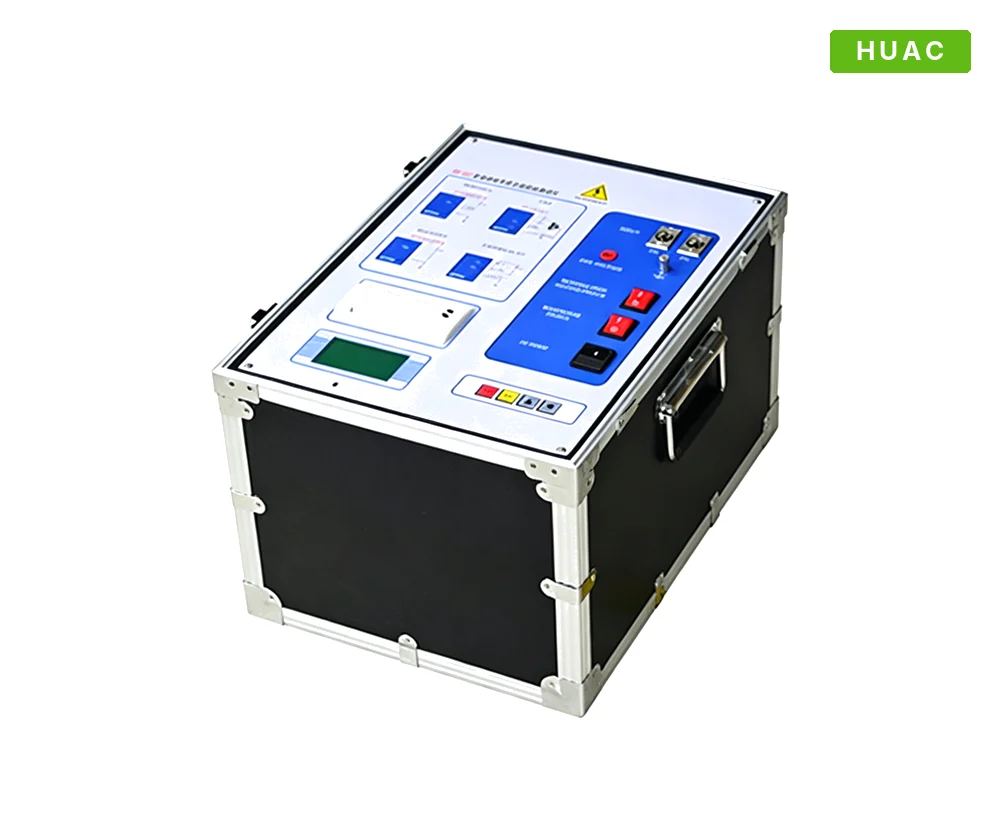
The HUAC-JS-1000 supports both connections, with a built-in source from 0.5 to 10 kV.
Testing a two-winding transformer
A two-winding transformer has three insulation systems: high-voltage winding to earth (CH), low-voltage winding to earth (CL) and between the windings (CHL). To measure them:
- Isolate the transformer, disconnect all bushings from the system and earth the tank.
- Short-circuit each winding on itself: connect all HV terminals together, including the neutral, and all LV terminals together. This removes the winding inductance from the measurement.
- Apply the test voltage to the HV winding. Measure CHL with normal connection (LV winding to the measuring input), and CH with reverse connection while the LV winding is guarded or earthed, according to the test set's instructions.
- Repeat with the test voltage on the LV winding to measure CL, using a test voltage that does not exceed the rating of the LV winding.
Measure at the same test voltage every time, commonly 10 kV for windings rated 10 kV and above, so that results can be compared over the years.
Testing bushings
Condenser bushings above about 72.5 kV usually have a test tap. With the bushing installed and its winding shorted and energised from the test set, connect the measuring input to the test tap and use normal connection to measure the main insulation C1 between the conductor and the tap. C2, between the tap and the earthed flange, is measured separately at a low voltage given by the bushing manufacturer. Always refit the test tap cover after the test: an open test tap in service will fail.
Judging the results
There is no single pass mark that suits every asset, so judge the results in three ways:
- Against the factory or nameplate value. Bushings have nameplate values of C1 and tan δ. A rising tan δ or a change in capacitance from the nameplate value needs investigation; many utilities use a capacitance change of about 5 % as a trigger to investigate further.
- Against earlier results on the same asset. The trend matters more than the absolute number. A tan δ that has doubled since the last test is a warning even if it is still low.
- Against similar assets. Compare the three bushings of the same transformer and transformers of the same design.
As a guide, new oil-paper transformer insulation typically measures well below 0.5 % at 20 °C, and values above about 1 % deserve a closer look. Use your utility's criteria or the manufacturer's data where they exist.
Temperature and humidity
Tan delta of oil-paper insulation rises with temperature, so a result is only comparable with earlier ones if it is corrected to a reference temperature, normally 20 °C. Record the top-oil temperature with every test and apply the correction factors from your standard or the manufacturer. Avoid testing when the insulation is below 0 °C, when frozen moisture gives misleadingly low readings. On humid days, clean and dry the bushing surfaces, because surface leakage adds losses that are not in the insulation.
Interference in energised substations
Next to live equipment, capacitive coupling injects 50 or 60 Hz current into the measurement and can make tan δ readings wrong or even negative. Modern test sets measure at two frequencies just above and below the power frequency, for example 45 and 55 Hz, and combine the results to remove the interference. Keep the test leads short and away from energised conductors, and use the guard connections as the test set's manual describes.
Related tests
Tan delta is one part of a full transformer condition assessment. Combine it with winding resistance, turns ratio, SFRA and an oil breakdown voltage test. See all transformer test equipment.