Transformer
Insulating oil breakdown voltage (BDV) test to IEC 60156, step by step
The breakdown voltage (BDV) test is the quickest check of insulating oil quality. It measures the voltage at which a sample of oil, between two electrodes a fixed distance apart, stops insulating and flashes over. Water, fibres and other particles lower the breakdown voltage sharply, so a low result is an early warning that the oil, and the insulation it protects, needs attention. This guide walks through the test as described in IEC 60156 and explains how to avoid the most common sources of error.
What breakdown voltage tells you, and what it does not
Clean, dry mineral oil has a high dielectric strength. Dissolved and free water and conducting particles, especially wet cellulose fibres, line up in the electric field between the electrodes and start the breakdown. BDV is therefore a sensitive indicator of contamination.
It is not a measure of oil ageing. Oxidised oil can still have a good breakdown voltage. To judge ageing, combine BDV with an acidity (acid value) test, dielectric dissipation factor, interfacial tension and dissolved gas analysis, as recommended in IEC 60422 for oil in service.
Standards at a glance
| Standard | Electrodes and gap | Voltage rise | Result |
|---|---|---|---|
| IEC 60156 | Spherical or spherical-segment, 2.5 mm | 2 kV/s | Mean of six breakdowns |
| ASTM D1816 | VDE (mushroom) electrodes, 1 or 2 mm | 0.5 kV/s | Mean of five breakdowns |
| ASTM D877 | Flat disc electrodes, 2.5 mm | 3 kV/s | Mean of five breakdowns |
Results from different methods are not comparable, so always state the standard with the result and use the same method for trending. The rest of this guide follows IEC 60156.
Step 1: take a representative sample
Most poor BDV results are caused by sampling, not by the oil. Follow IEC 60475 for sampling from transformers:
- Use clean, dry glass or approved containers, rinsed with the oil being sampled.
- Flush the sampling valve and the first litre or so of oil to waste before filling the container.
- Avoid sampling in rain or high humidity, and close the container immediately.
- Protect the sample from light and test it as soon as practical.
If the sample is cold, let it warm to room temperature in its closed container before you open it, otherwise moisture from the air will condense in the oil.
Step 2: prepare the test cell
Check the electrode gap with a gauge, at 2.5 mm for IEC 60156, and clean the cell and electrodes. Rinse the cell with a portion of the sample, then fill it slowly, pouring down the side of the cell to avoid air bubbles. Bubbles in the gap lower the breakdown voltage just as particles do.
Step 3: run the test
- Let the filled cell stand for about 5 minutes so that air bubbles can escape.
- Raise the voltage at 2 kV/s from zero until breakdown. The tester must cut off the voltage within a few milliseconds of breakdown to limit the carbon formed in the oil.
- Wait at least 2 minutes, stirring gently if your procedure uses a stirrer, so that breakdown products disperse.
- Repeat until you have six breakdowns, and calculate the mean.
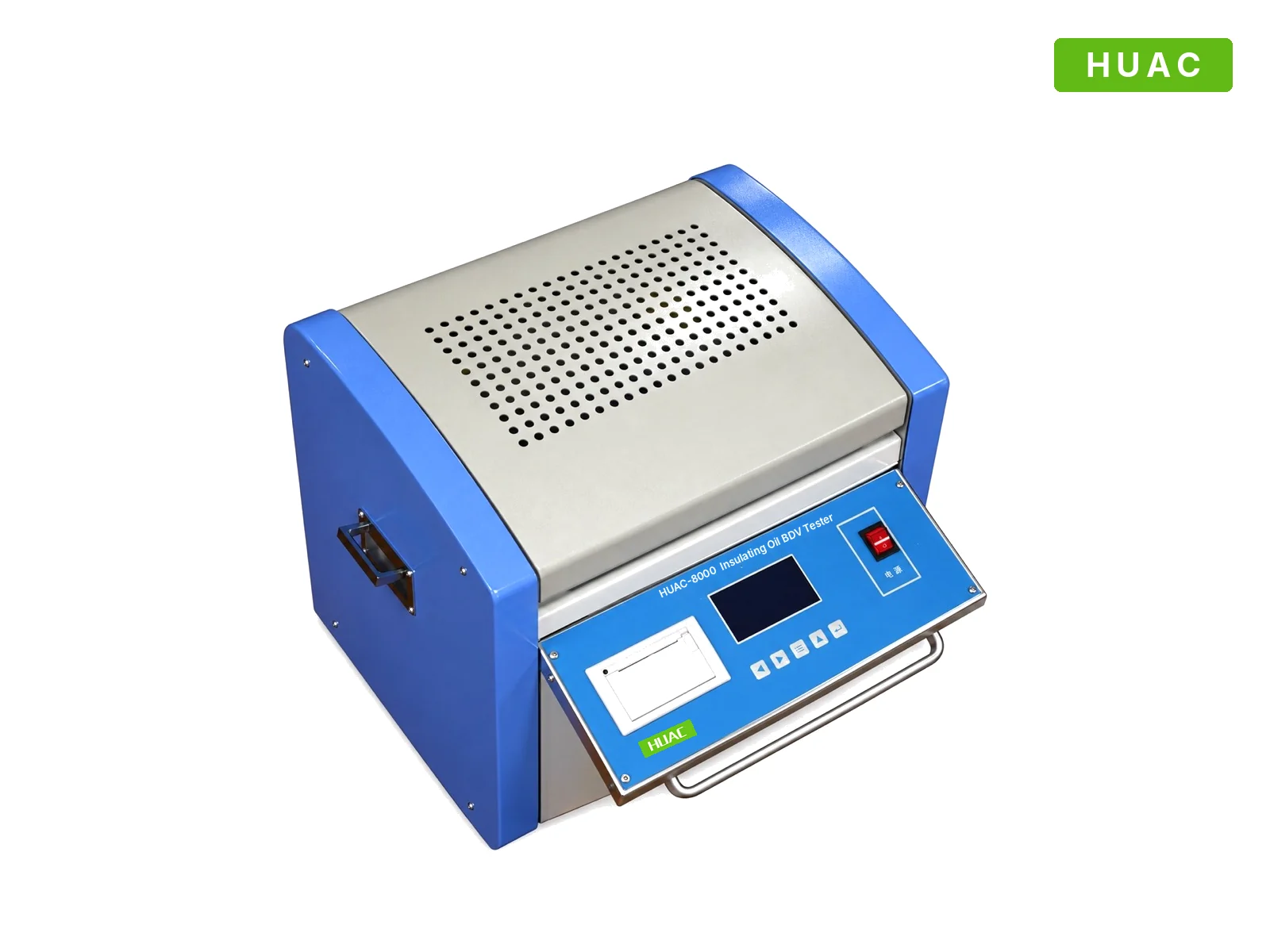
An automatic tester such as the HUAC-8000 oil BDV tester runs the whole sequence (raise, hold, stir and stand) automatically, with an adjustable rise rate, standing time and number of breakdowns, then prints the breakdown values and their average, so the timing is the same on every test.
Step 4: check the spread before you trust the mean
Look at the six individual values as well as the average. A wide scatter, or a first breakdown much lower than the rest, usually means bubbles, a particle that was burned off, or a dirty cell. Clean the cell and test a fresh portion of the sample before reporting a low result.
Interpreting the result
Acceptance values depend on whether the oil is new or in service and on the voltage class of the equipment. For oil in service, IEC 60422 classifies the breakdown voltage as good, fair or poor according to the equipment category, with higher limits for higher system voltages. New oil delivered to site and oil after treatment should meet the limits in your specification, which are normally higher still.
If the result is low:
- Retest a fresh sample to rule out sampling or cell contamination.
- Check moisture with a water content (Karl Fischer) test. High water content points to a leak, a failed breather or wet cellulose insulation.
- Treat the oil by filtering and vacuum dehydration, then retest. If the result drops again soon after treatment, the solid insulation is likely releasing moisture.
Frequently asked questions
What electrode gap and voltage rise does IEC 60156 use?
A 2.5 mm gap between spherical or spherical-segment electrodes, and a voltage rise of 2 kV/s. The result is the mean of six breakdowns.
Why are my six breakdown values so different?
Large scatter usually comes from air bubbles, particles, a dirty cell or too short a pause between breakdowns. Clean the cell, refill carefully, wait for bubbles to escape and repeat the test.
Does a good breakdown voltage mean the oil is healthy?
Not on its own. BDV shows contamination by water and particles, but not ageing. Combine it with acidity, dissipation factor, interfacial tension and dissolved gas analysis to judge the overall condition of the oil.
Can I compare results from IEC 60156 and ASTM D1816?
No. The electrodes, gap and rate of rise are different, so the breakdown voltages are different too. Report the standard used and trend results only against tests made to the same method.