Transformer
Short-circuit impedance vs SFRA: detecting transformer winding deformation
Transformer windings can move. Short-circuit currents produce large electromagnetic forces, transport can shake a transformer hard, and clamping pressure falls as insulation ages. A winding that has moved may still pass ratio, resistance and insulation tests, yet withstand the next fault much worse. Two field tests detect winding deformation: short-circuit impedance (leakage reactance) and sweep frequency response analysis (SFRA). This guide compares them and explains when to use each.
Short-circuit impedance
The short-circuit impedance of a transformer depends on the geometry of its windings: the gap between the HV and LV windings and their height. If a winding moves or deforms, the leakage flux path changes and so does the impedance. The test short-circuits one winding and applies a low voltage to the other, measuring voltage, current and phase to calculate the impedance, usually per phase.
- Reference: the nameplate or factory test report value, and earlier field measurements.
- Result: a single number per phase, easy to compare and to put in a report.
- Sensitivity: good for overall deformation, such as radial buckling or axial displacement of a whole winding; less sensitive to small, local changes.
A common field guideline, used in power-industry practice, treats a deviation of up to about ±2 % from the reference as normal, ±2 % to ±5 % as needing closer monitoring, and more than ±5 % as a reason to investigate before returning the transformer to service. Your own utility's criteria take precedence.
Sweep frequency response analysis (SFRA)
SFRA injects a low-voltage sine wave into one end of a winding and measures the response at the other end, sweeping from a few hertz or kilohertz to around 1–2 MHz. The result is a curve of amplitude, and phase, against frequency: the fingerprint of the winding's network of inductances and capacitances. Any mechanical change alters that network and shifts the curve.
- Reference: an earlier SFRA of the same transformer is best; otherwise a sister unit of the same design, or comparison between the three phases.
- Result: a set of curves that need comparison and interpretation.
- Sensitivity: very sensitive to local changes such as a displaced section, a loose clamping structure or a shorted turn, and different frequency ranges point to different parts of the transformer.
IEC 60076-18 describes the measurement of frequency response. For how to read the curves, see our guide to reading SFRA after transport.
Side by side
| Short-circuit impedance | SFRA | |
|---|---|---|
| What it measures | Leakage reactance at power frequency | Frequency response over a wide band |
| Reference needed | Nameplate value is enough | Earlier fingerprint or sister unit works best |
| Detects | Overall deformation of a winding | Local and overall deformation, core and connection problems |
| Result | One number per phase, simple pass/investigate | Curves that need interpretation |
| Sensitive to test setup | Low | High: leads, earthing and connections must be repeatable |
When to use which
- Commissioning and after transport: take an SFRA fingerprint. It becomes the reference for the rest of the transformer's life. Measure short-circuit impedance and compare it with the factory value.
- After a through-fault or a protection trip: run both. Short-circuit impedance gives a quick decision; SFRA shows whether there is local damage that the impedance does not reveal.
- Older transformers without a fingerprint: short-circuit impedance compared with the nameplate is the most direct check; use SFRA to compare phases and to set a baseline for the future.
The two tests complement each other, and many utilities run both. Combine them with winding resistance and turns ratio tests to separate mechanical damage from electrical faults.
Good practice
- Isolate the transformer and disconnect all bushings from the system before testing.
- Record the tap position and test on the same tap every time; impedance and the frequency response both depend on it.
- For SFRA, use the shortest possible earth braids at the bushing flanges and document the connections, so the next test can repeat them exactly.
- For short-circuit impedance, make the short-circuit connection with heavy, short conductors: their resistance adds to the result.
Equipment
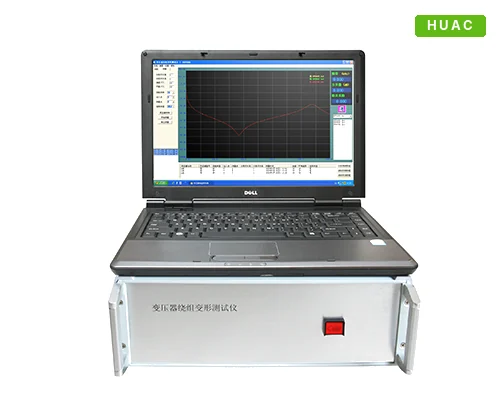
HUAC offers the HUAC-ZK-III short-circuit impedance tester, the HUAC-RZ-3000 SFRA with built-in PC, and the HUAC-RZ-II, which combines both methods. See all transformer test equipment.